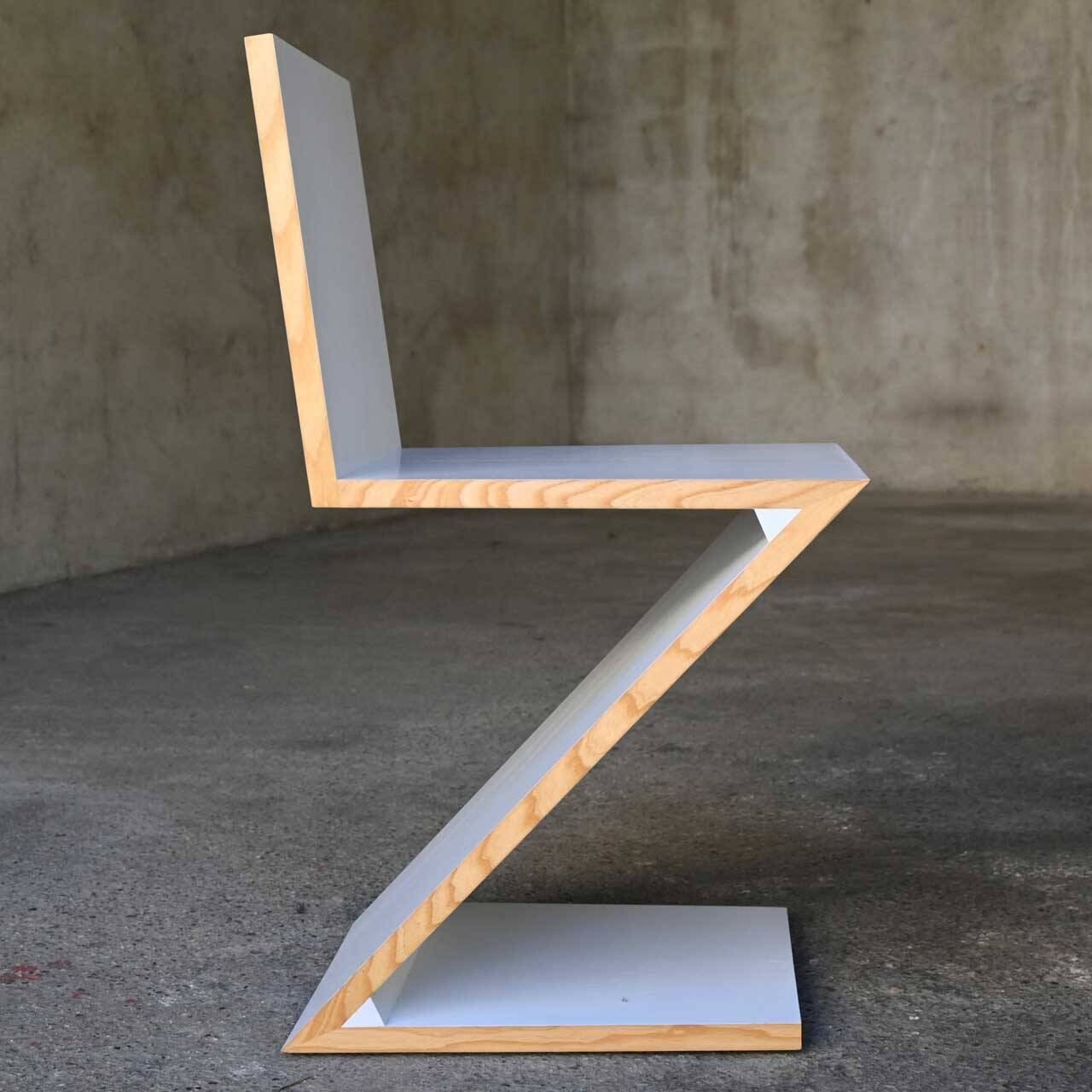
Gerrit Thomas Rietveld
Gerrit Thomas Rietveld (Utrecht, June 24, 1888 – Utrecht, June 25, 1964) was one of the leading figures of the De Stijl movement and a central figure in the evolution of modernist design and architecture. The son of a carpenter, he began working in his father’s workshop, developing a direct relationship with materials, construction, and craftsmanship. In 1917 he opened his own workshop and started designing innovative furniture, including the famous Red and Blue Chair (1918–1923), which became a symbol of Neo-Plasticist aesthetics for its rigorous use of orthogonal lines, primary colors, and exposed structure.
In 1924 he created, in collaboration with Truus Schröder, the Schröder House in Utrecht: an icon of modern architecture characterized by fluid spaces, movable partitions, and an essential formal language. In the following years, he expanded his work to residential architecture, social housing, and the design of inexpensive and modular furniture, consistent with the idea of democratizing good design.
Rietveld was not only a formalist, but an innovator who sought to unite artistic avant-garde principles with functionality and everyday life. His contribution profoundly influenced 20th-century design, anticipating minimalism, rationalism, and the industrial approach to production. He died in 1964, leaving a design legacy that remains an international point of reference for architects and designers.
Gerrit Thomas Rietveld
Gerrit Thomas Rietveld (Utrecht, June 24, 1888 – Utrecht, June 25, 1964) was one of the leading figures of the De Stijl movement and a central figure in the evolution of modernist design and architecture. The son of a carpenter, he began working in his father’s workshop, developing a direct relationship with materials, construction, and craftsmanship. In 1917 he opened his own workshop and started designing innovative furniture, including the famous Red and Blue Chair (1918–1923), which became a symbol of Neo-Plasticist aesthetics for its rigorous use of orthogonal lines, primary colors, and exposed structure.
In 1924 he created, in collaboration with Truus Schröder, the Schröder House in Utrecht: an icon of modern architecture characterized by fluid spaces, movable partitions, and an essential formal language. In the following years, he expanded his work to residential architecture, social housing, and the design of inexpensive and modular furniture, consistent with the idea of democratizing good design.
Rietveld was not only a formalist, but an innovator who sought to unite artistic avant-garde principles with functionality and everyday life. His contribution profoundly influenced 20th-century design, anticipating minimalism, rationalism, and the industrial approach to production. He died in 1964, leaving a design legacy that remains an international point of reference for architects and designers.